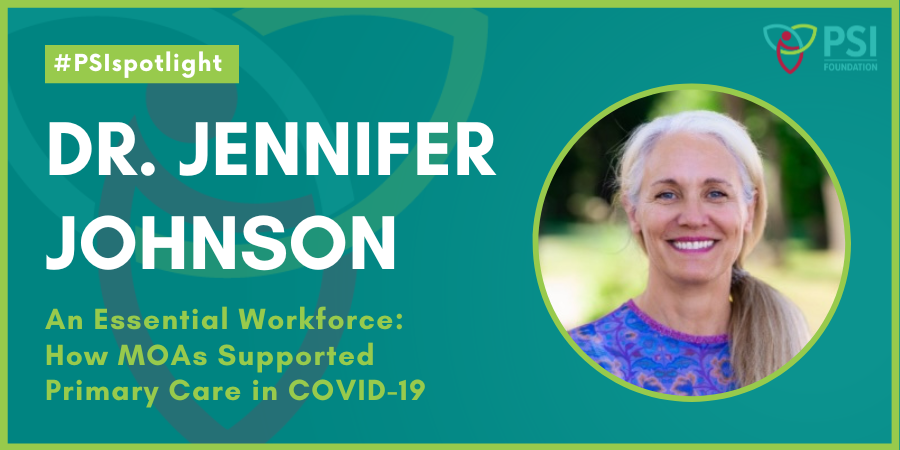
“The grant from PSI helped me conduct my first independent study as the PI and research team lead. As a rural community primary care provider geographically distant from any university, it was greatly appreciated that PSI provided the support to conduct qualitative research on MOAs (Medical Office Assistants); an important, but understudied group in health care.” -Dr. Jennifer Johnson
About Dr. Jennifer Johnson
Dr. Jennifer Johnson was a family physician in Penetanguishene, Ontario for 28 years. She recently transitioned to leading the hospitalist service at the Georgian Bay General Hospital and practicing primary care as a locum. She is also an Adjunct Research Professor at Western University. Dr. Johnson obtained her medical degree from McMaster University–completing her residency in family medicine at the University of Calgary.
Dr. Johnson’s research interests include looking at how different occupations (including retirement) impact the health of patients that are seen in primary care. This interest extends to the health of family physicians, especially in the era of global pandemics. She is also curious about health systems; the primary care workforce; highway safety; and the effects of over-screening, overdiagnosis, and overtreatment on patients.
About the Funded Study
MOAs–otherwise referred to as receptionists or clerks–are the first point of contact for patients seeking family medicine services. Despite playing a central role in medical office operations and clinic flow, MOAs have been largely absent from health research. MOAs historically receive low wages and have little influence over clinic decision-making. This PSI-funded study, titled “Impact of the Covid-19 Pandemic on the Roles, Responsibilities and Health of Medical Office Assistants Working in Family Medicine Clinics in Ontario: Implications for Primary Care Access and Quality,” set out to fill this gap by documenting MOAs’ experiences during the COVID-19 pandemic–a period that placed intense pressure on primary care systems.
Dr. Johnson interviewed both MOAs and family physicians to understand how MOAs adapted during a period of rapid change. Her study’s findings revealed the depth of MOAs’ skills, relationships, and problem-solving abilities, many of which had gone unrecognized prior to the pandemic.
Impact of the Funded Study
Supported by the PSI New Investigator Grant, Dr. Johnson’s study found that the responsibilities of MOAs intensified significantly during the pandemic. As public health guidance shifted, MOAs were tasked with screening patients, delivering evolving COVID-19 information, enforcing masking and distancing policies, and ensuring clinic spaces were sanitized between visits. Many of them also played a key role in determining whether patients needed in-person care, or could be supported through phone or video visits.
MOAs relied heavily on their knowledge of the healthcare system and on the relationships they had built with patients. Their efforts helped reduce patient anxiety during a time of uncertainty and preserved access to primary care when many people needed it most. However, the increased demands came with challenges. MOAs reported higher levels of stress, frustration, and in some cases, verbal abuse from patients. These experiences highlighted the need for better training and tools to help MOAs manage conflict and maintain safe, respectful clinic environments.
The family physicians interviewed in the study emphasized that valuing, supporting, and including MOAs in decision-making processes were essential for a well-functioning primary care team. The study demonstrated that MOAs bring significant, untapped expertise and innovation. This expertise is needed in primary care systems now more than ever, as physician offices continue to operate under strain.
Dr. Johnson’s research has already informed real-world educational and system-level changes. Her findings were presented at Georgian College’s Program Advisory Committee meeting in October 2024, where instructors are now considering updating the MOA curriculum to include training in de-escalation and conflict management. The work was also highlighted at McWhinney Day in 2024, where it contributed to broader discussions on strengthening primary care teams. Dr. Johnson was invited to participate as a stakeholder in a larger MOA study being launched at Women’s College Hospital, reflecting the growing interest in improving support for MOAs across the province.
In addition to multiple poster and oral presentations at McWhinney Day 2023, Trillium Research Day 2023, and NAPCRG 2024 in Quebec City, this study has been published in the British Journal of General Practice Open, further widening its impact.
“The grant from PSI helped me conduct my first independent study as the PI and research team lead,” says Dr. Johnson. “As a rural community primary care provider geographically distant from any university, it was greatly appreciated that PSI provided the support to conduct qualitative research on MOAs (Medical Office Assistants); an important, but understudied group in health care.”
This study shows that MOAs are far more than administrative staff; they are essential healthcare workers whose contributions are critical for access, quality, and continuity of primary care. Their adaptability, patient relationships, and organizational insights are invaluable assets to the health system. As primary care continues to face resource shortages, the findings underscore the importance of investing in MOA training, well-being, and inclusion in team-based care.