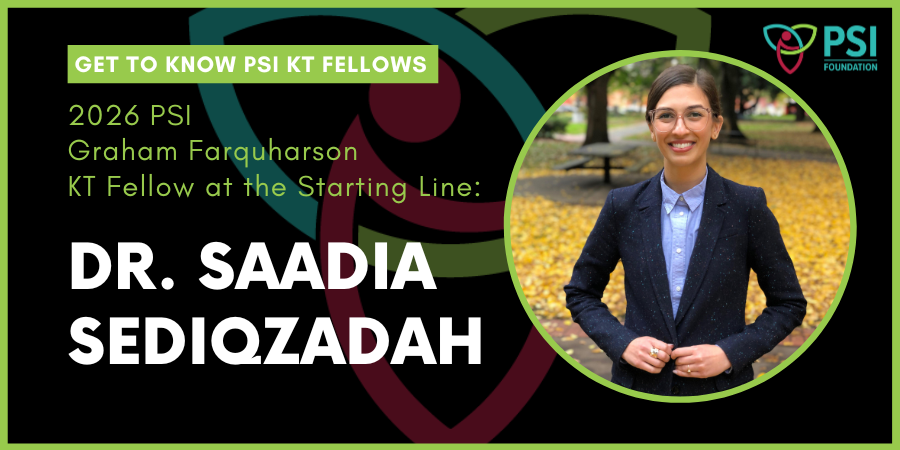
Upon receiving their approval letters and sharing the exciting news of the award with their community, the PSI Knowledge Translation (KT) Fellows begin preparing to get settled in their place at the starting line. As Dr. Saadia Sediqzadah embarks on her PSI KT Fellowship journey, we asked her few questions to know her beyond her recipient biography, as well as some notes she could pass on to future applicants.
Please use 3 words to describe how you feel as you begin your KT Fellowship.
Excited (!), grateful, and curious.
Why did you apply for the PSI Graham Farquharson KT Fellowship? How does this award align with your current research and career goals?
Since starting my career as a clinician-investigator, I have been fortunate to have some protected time to develop my research career. I soon realized thought that it is very difficult to apply for grants, start and conduct research projects, hire and manage research staff, etc., with only one protected academic day in my week. What this ultimately meant was working on the research side of my career in the evenings and weekends (i.e., outside of clinic time). And that worked fine…until I had kids. As any parent knows, having and raising kids is both beautiful and will also turn your life upside down. Time is at a premium. By securing this Fellowship and increasing my protected research time, I have been given the gift of more time to do the research right.
I have a rewarding clinical career supporting youth living with psychotic illnesses. I truly love my clinical work but there are knowledge-gaps that impact the quality of care I can provide. I am driven to help try to fill these gaps and disseminate evolving knowledge in the field. As such, I applied for the PSI Graham Farquharson KT Fellowship and here we are today.
The Fellowship aligns with my research and career goals in other ways, too. I look forward to leaning into the KT side of my research projects. For example, we are starting a project to develop a patient decision aid to guide medical decision-making for youth living with psychosis. We are currently recruiting people with lived experience to join our steering committee which will oversee the entire three-year project. Additionally, knowledge users including patients, family members/caregivers, allied healthcare providers, and psychiatrists and family doctors will co-design the patient decision aid. This integrated KT approach was in part inspired by the KT plan I put together my PSI Graham Farquharson KT Fellowship application. It’s wonderful to see it in action already.
What are 3 to 5 general tips and notes you would pass on to those preparing their KT Fellowship application?
1) Start early. It’s a huge application with many components. Give yourself a couple of months to work on it so you don’t feel rushed and your reviewers have adequate time to provide feedback, and you have enough time to integrate their feedback.
2) Seek feedback. At Li Ka Shing Knowledge Institute, we have mandatory peer review for grant and salary award applications. If you are not at a research institute and/or do not have access to formal peer review, seek it out on your own. Reach out to colleagues with expertise especially in KT. If you have a great reviewer in mind and you don’t know them personally, even better – they are more likely to provide impartial and honest feedback. Don’t be shy – the worst they can say is no. Just do it.
3) Applying is *never* a waste of time. This mantra has served me well with every grant or award application this past year. There was a time where I used to think for certain opportunities: “Ah, I probably won’t win, so why bother.” Now, I don’t see any application as a waste of time. Why? Because even if I don’t win, at least I have all that background work ready to go for the next application. In other words, the most work happens the first time around. After that, it’s simply a matter of refining, reformatting, copying and pasting into future applications until you finally secure that win.
Good luck!