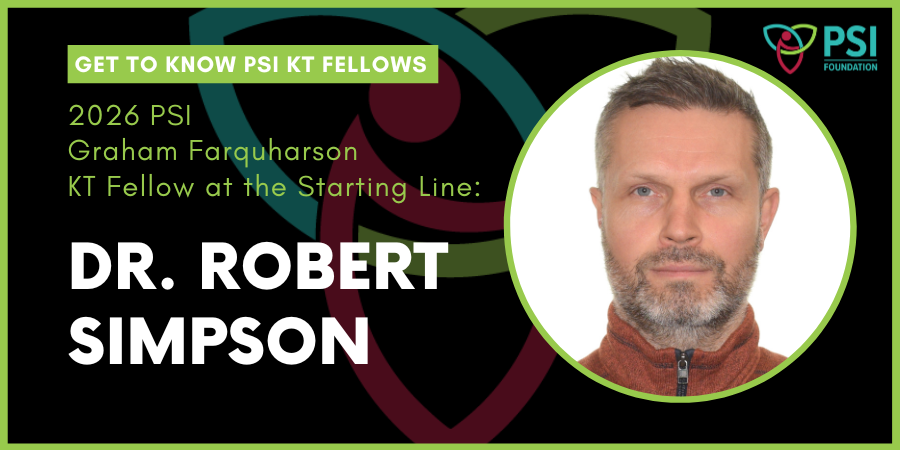
Upon receiving their approval letters and sharing the exciting news of the award with their community, the PSI Knowledge Translation (KT) Fellows begin preparing to get settled in their place at the starting line. As Dr. Robert Simpson embarks on their KT Fellowship journey, we asked them few questions to know them beyond their recipient biography, as well as some notes they could pass on to future applicants.
Please use 3 words to describe how you feel as you begin your KT Fellowship.
Excited, engaged, committed (but also a little nervous).
Why did you apply for the PSI Graham Farquharson KT Fellowship? How does this award align with your current research and career goals?
I applied for this award because I felt the PSI definition of knowledge translation (‘taking clinical research findings and encoding them into clinical policies’) aligned very well with where my research was at the time. I had completed many years of preparatory work to understand the scope of the issue at hand i.e., high levels of psychological distress in people with multiple sclerosis contrasted with limited treatment offerings in clinical care, but strong evidence in knowledge syntheses to support the effectiveness of psychological therapies in this context. The need to translate this into practice was thus really clear and I think that created a strong sense of purpose in my mind to present the proposal to PSI. I’m glad I did.
What are 3 to 5 general tips and notes you would pass on to those preparing their KT Fellowship application?
- Be intentional and be organized – although there is a good lead in time from advertisement of the fellowship to submission of a letter of intent and then the full application, there is a lot of documentation required and this involves requests for time and support from collaborators, mentors, and sponsors, who themselves will need time to review materials and provide any necessary documentation.
- Be confident in communicating your passion for the work you propose. You would not be doing this unless it is important and the passion you have will sustain you to be successful in your project whether in this opportunity or the next.
- Draw on the generous and invaluable support of your trusted colleagues and mentors. Their critical reviews can greatly enhance the messaging in how you present your application, and their expertise, which likely differs from your own, can bring enhanced design thinking and application of methods to bolster your ideas.