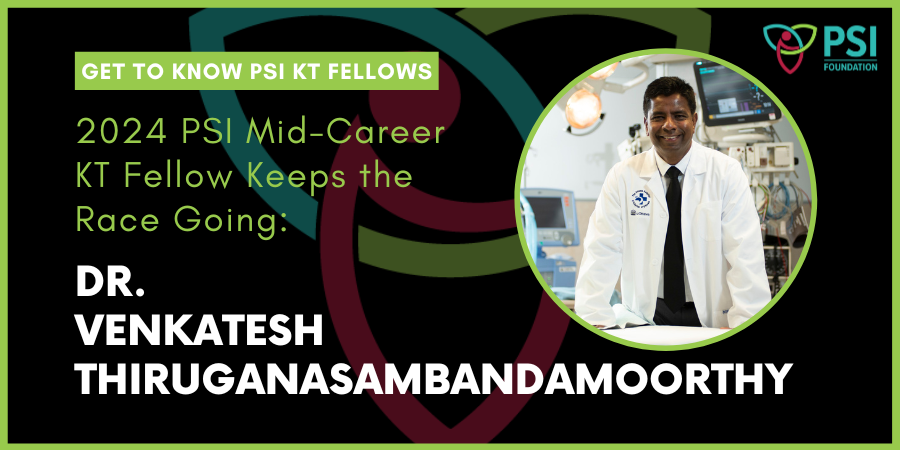
Once our PSI Knowledge Translation (KT) Fellows take off from the starting line, they make strides as they move their knowledge translation activities and research program forward. As the finish line becomes clearer in their sight, we asked our 2024 PSI Mid-Career KT Fellow, Dr. Venkatesh Thiruganasambandamoorthy, some questions to share his progress thus far, and what he looks forward to in the remainder of their KT Fellowship.
What are some of your accomplishments from the KT Fellowship thus far?
The overarching objective of my PSI Mid-Career KT Fellowship was to lead four major research initiatives focused on syncope care and knowledge translation:
- National Implementation of the Canadian Syncope Pathway (CSP):
I led a multicentre stepped-wedge cluster randomized trial to implement the Canadian Syncope Risk Score (CSRS)–based CSP across 16 hospitals in Canada. This work was supported by a CIHR grant of $1.25 million. Patient recruitment was completed in April 2026, and we are currently conducting data cleaning and analysis to evaluate the clinical and system-level impact of the pathway. - Knowledge Translation Process Evaluation:
This project was funded by PSI ($195,500) and aimed to formally evaluate how evidence-based implementation strategies influence CSP uptake in clinical practice. The study includes (1) pre- and post-implementation surveys at all 16 participating hospitals, with post-implementation surveys underway, and (2) qualitative interviews with physicians and clinical staff across low-, medium-, and high-uptake sites at four Ontario hospitals. The interview component is complete, and the findings have been submitted for publication. Through this work, I co-mentored a postdoctoral fellow who has since secured a faculty appointment. - Validation and Prehospital Implementation of the Canadian Prehospital Syncope Risk Score (CPSRS):
With CIHR funding of $397,800, we initiated a study to validate the CPSRS and prepare for its implementation in the prehospital setting, with the goal of diverting very-low-risk patients away from the emergency department. Recruitment began in late 2025, and we are currently expanding participation to additional EMS organizations. - Development of an Artificial Intelligence–Enabled Syncope Algorithm:
This project aims to develop an AI-based clinical decision support tool that integrates historical and comorbidity data to guide emergency department investigations, predict syncope etiology, and assess 30-day serious outcomes using the CSRS. Start-up funding from the local academic medical organization supported study design and pilot enrollment. Recruitment is currently underway at both emergency departments of The Ottawa Hospital.
In addition to these core projects, my broader research program received CIHR funding ($520,000) for a randomized controlled trial evaluating live cardiac monitoring for higher-risk syncope patients discharged from the emergency department. The program has also expanded into AI research, supported by $375,000 in funding, focusing on natural language processing and machine learning applications in chest pain presentations, diagnosis of obstructive myocardial infarction, and AI-assisted translation to promote equitable clinical care and patient education.
During the fellowship, I received the University of Ottawa Exceptional Leadership Award (2024), was nominated for the 2026 Association of Faculties of Medicine of Canada Clinician Scientist Award and was recognized by CIHR for outstanding contributions to peer review. In 2025, I was appointed Chief Research Information Officer for The Ottawa Hospital Research Institute and currently serve as Chair of the Society for Academic Emergency Medicine GRACE-5 Syncope Guidelines, which are forthcoming.
Throughout the fellowship, I have also mentored a PhD student completing a thesis on ethical and methodological aspects of prediction tool knowledge translation, as well as a postdoctoral fellow from France whose work focused on the development and implementation of emergency department prediction tools.
Please describe any challenges/barriers that you have encountered thus far and what actions were/will be taken to resolve them?
After the COVID pandemic, lack of trained health care personnel in the emergency department (ED) and in the prehospital setting has placed an enormous strain on the system leading to ED closures, long wait times and delays in ambulance off loading. It has been extremely challenging engaging ED physicians, paramedics, and their respective institutions/organizations to participate in research given the operational pressures.
We have mitigated these challenges by integrating research into clinical care and harnessing the capabilities of the electronic health records (EHR) and information technology to achieve our research data collection objectives.
What are some items/deliverables that you look forward to coming to fruition in the remainder of your KT Fellowship?
I hope to accomplish the following knowledge translation activities in the next year prior to the completion of my fellowship:
- Publish the results of the large SW-CRT assessing the implementation of the CSRS
- Publish the SAEM GRACE-5 guidelines on ED management of syncope
- Obtain funding to develop an AI algorithm for ED syncope care beyond the pilot phase
- Publish the other AI studies that are underway
What are some things that surprised you during your fellowship thus far?
One of the most unexpected and positive aspects of my fellowship has been the research potential of modern electronic health record platforms. Through targeted training on the EPIC system, I have been impressed by its capacity to support robust clinical research. In the context of mounting operational challenges, these enhanced EHR capabilities have enabled our program to advance evidence-based patient care through innovative, and integrated research approaches.